 +1 646 595 1666
  sales@hireecom.com
 +91 8287203228

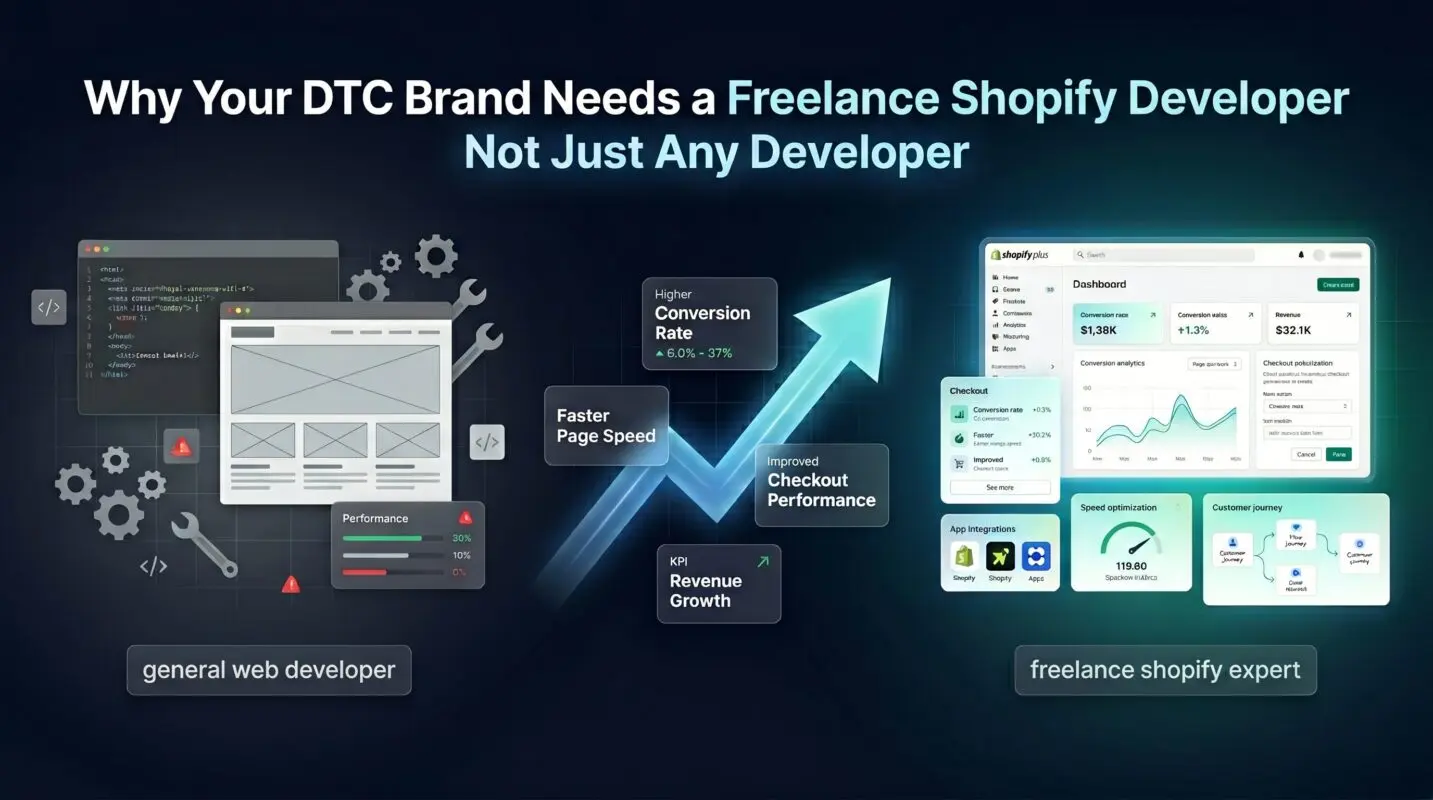
Why Your DTC Brand Needs a Freelance Shopify Developer Not Just Any Developer
The DTC (Direct-to-Consumer) model has completely redefined how brands sell in 2026. No middlemen. No retail dependency. Just your brand, your store, and your customer.
But here’s the hard truth: a generic Shopify store built on a default theme with basic settings will not compete in today’s DTC landscape. Your customers expect speed, personalization, and a seamless experience from the first click to the confirmation email.
That’s exactly why the smartest DTC brands are investing in a freelance Shopify developer for DTC brand, someone who doesn’t just know Shopify, but understands the DTC business model deeply.
This guide tells you everything you need to know.
What Makes a DTC Shopify Store Different?
Not all Shopify stores are built the same. A DTC brand has unique requirements that a generic eCommerce developer may not understand:
1. Brand-First Experience
DTC brands win on brand differentiation. Your Shopify store needs to feel completely unique, not like 10,000 other stores using the same theme. This requires custom design, custom Liquid code, and a developer who thinks like a brand strategist.
2. Conversion-Optimized Everything
Every pixel on a DTC store should serve one purpose: moving the customer closer to purchase. Custom product pages, sticky add-to-cart buttons, personalized upsells, exit-intent popups, and one-click checkout flows are not “nice to haves” ; they’re conversion essentials.
3. Customer Retention Built Into the Tech
DTC success is built on lifetime value not one-time sales. Your Shopify developer needs to integrate loyalty programs, subscription flows, SMS/email capture systems, and post-purchase experiences directly into your store architecture.
4. Speed as a Core Feature
A 1-second delay in page load can reduce conversions by 7%. For a DTC brand spending on paid ads to drive traffic, a slow store is burning your marketing budget. A skilled developer optimizes Core Web Vitals, lazy loads assets, and minimizes third-party script bloat.
Shopify Customization Examples – What DTC Brands Are Actually Building
Let’s get specific. Here are real Shopify customization examples that high-performing DTC brands implement to stand out and convert better:
Custom Homepage Sections Dynamic hero banners that change based on the traffic source different messaging for paid social vs. organic search vs. email campaigns.
Personalized Product Pages Upsell and cross-sell sections that dynamically change based on what’s in the customer’s cart, powered by metafields and custom Liquid logic.
Subscription + One-Time Purchase Toggle A single product page offering both subscription and one-time purchase options with real-time price comparison critical for CPG and consumable brands.
Custom Bundle Builder Interactive bundle pages that let customers mix and match products built entirely in Shopify without third-party apps, reducing page load overhead.
Loyalty Tier Display Real-time loyalty point display on product pages and cart built custom to match the brand’s specific loyalty program logic.
Localized Checkout Flows Multi-currency, multi-language checkout experiences for DTC brands selling across international markets.
Each of these requires a developer who deeply understands Shopify’s architecture, not just a template modifier.
Shopify Developer for Marketplace – Expanding Beyond Your Owned Store
In 2026, the smartest DTC brands don’t just rely on their Shopify store. They sell everywhere their customers are Amazon, Walmart, eBay, TikTok Shop, and more.
This is where a Shopify developer for marketplace integration becomes critical.
What Shopify Marketplace Integration Covers:
Inventory Sync Real-time inventory synchronization between your Shopify store and all marketplace channels zero overselling, zero manual updates.
Order Management Centralization All marketplace orders flowing into your Shopify backend for unified fulfillment, tracking, and customer communication.
Product Feed Management Automated product feed pushing to Amazon, Google Shopping, Meta Catalog, and other channels keeping listings accurate and optimized.
Pricing Rules by Channel Different pricing strategies for your Shopify store vs. Amazon vs. Walmart all managed centrally with custom logic.
Returns and Refunds Unification Cross-channel returns managed from a single Shopify dashboard no more juggling between platforms.
A developer who specializes in shopify marketplace integration builds these systems once and runs them reliably forever eliminating the operational chaos that kills scaling DTC brands.
Why Hire eCommerce Developers Who Specialize – Not Generalists
Here’s a mistake brands make repeatedly: hiring a “web developer” and expecting eCommerce expertise.
General web developers are skilled at building websites. eCommerce developers are skilled at building stores that sell. The difference matters enormously.
When you hire ecommerce developers with Shopify specialization, you get:
- Knowledge of Shopify’s Liquid templating language not just HTML/CSS
- Experience with Shopify’s checkout extensibility (critical for Shopify Plus)
- Understanding of metafields, metaobjects, and dynamic content systems
- Familiarity with Shopify’s app ecosystem what to build custom vs. what to buy
- Conversion rate optimization knowledge baked into development decisions
- Experience with headless Shopify for brands needing ultimate frontend flexibility
Generalist developers learn these things on your project and your brand pays for that learning curve.
5 Questions to Ask Before Hiring a Freelance Shopify Developer
To make sure you’re hiring the right person for your DTC brand, ask these before committing:
- Can you show me 3 live DTC Shopify stores you’ve built or significantly contributed to? Portfolio is non-negotiable. Look for stores similar to your brand in terms of complexity and category.
- Have you built Shopify marketplace integrations before? If multi-channel is on your roadmap, verify their experience now, not after you’re locked in.
- How do you approach Core Web Vitals and page speed optimization? A great developer proactively optimizes. If they look confused by the question, move on.
- What’s your process for Shopify theme customization vs. custom builds? You want to understand whether they’ll start from a solid foundation and customize intelligently, or rebuild everything from scratch unnecessarily.
- How do you handle ongoing support and emergency fixes? Your store runs 24/7. You need a developer who can respond quickly when something breaks, especially around peak sales periods.
Why HireEcom for Your Shopify Development
At HireEcom, we’ve built our developer network specifically around eCommerce and Shopify DTC expertise is one of our deepest strengths.
Our Shopify developers have:
- Built and scaled DTC stores across health, beauty, apparel, food, and tech categories
- Delivered complex shopify marketplace integration for brands selling on Amazon, Walmart, and more
- Created custom Shopify experiences that consistently outperform industry-average conversion benchmarks
- Deep experience with Shopify Plus for high-growth and enterprise DTC operations
And unlike generic freelance platforms, every developer at HireEcom is pre-vetted specifically for eCommerce knowledge not just general coding ability.
Ready to Build a Shopify Store That Actually Converts?
Your DTC brand deserves more than a template. Let’s build something that performs.
Hire a Freelance Shopify Developer for Your DTC Brand at HireEcom →
40-hour risk-free trial. Onboard in 48 hours. No commitment required.
FAQs
Q: What does a freelance Shopify developer for a DTC brand actually do differently?
A: They go beyond basic setup building custom brand experiences, conversion-optimized flows, subscription models, loyalty integrations, and marketplace connections specifically designed for direct-to-consumer selling.
Q: How much does Shopify marketplace integration cost?
A: It depends on the number of channels and complexity of the integration. HireEcom offers flexible hourly and project-based pricing contact us for a free estimate.
Q: Can a Shopify developer build custom features not available in standard apps?
A: Yes. A skilled developer can build fully custom Shopify sections, metafield-powered dynamic content, and bespoke checkout flows that go far beyond what off-the-shelf apps offer.
Q: How long does it take to hire a Shopify developer through HireEcom?
A: Most clients are onboarded within 48 hours significantly faster than traditional hiring or freelance platforms.
Q: Is a dedicated developer better than a one-time freelancer for DTC brands?
A: For serious DTC brands, yes. A dedicated developer builds deep familiarity with your store, your code, and your brand which directly improves output quality and reduces bugs over time.