 +1 646 595 1666
  sales@hireecom.com
 +91 8287203228

Headless Shopify Development in 2026: Is It Right for Your eCommerce Brand?
There’s a term gaining serious momentum in eCommerce circles in 2026 “headless.” You’ve probably heard it. Maybe your developer mentioned it. Maybe you saw it in a competitor’s job listing. Maybe an agency pitched it to you with impressive sounding promises about performance and flexibility.
But what does headless Shopify development actually mean? When does it make sense? And when is it overkill?
This guide cuts through the buzzwords and gives you a practical, honest breakdown so you can make the right decision for your brand.
What Is Headless Shopify Development?
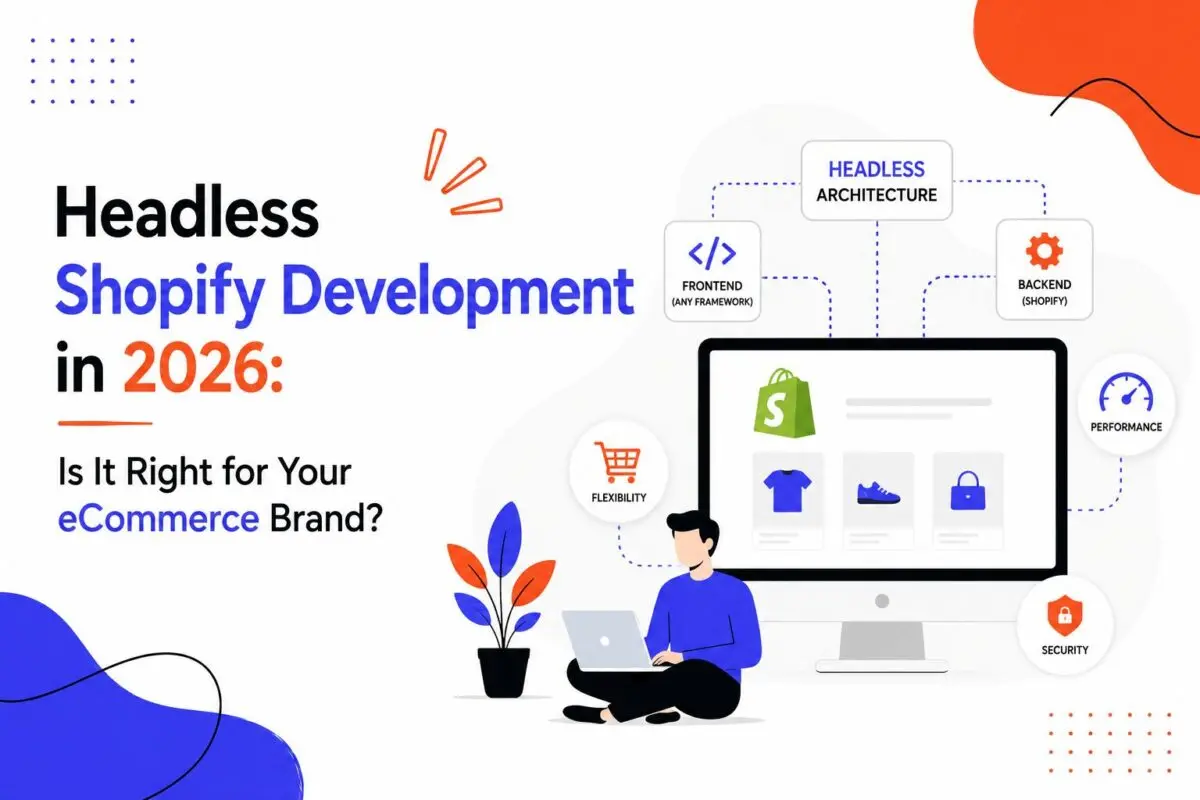
Traditional Shopify stores are “coupled” meaning Shopify controls both the backend (products, orders, inventory, checkout) and the frontend (what the customer actually sees and interacts with in the browser).
Headless Shopify development “decouples” these two layers. Shopify continues to handle everything on the backend but the frontend is built independently using modern JavaScript frameworks like React (Next.js), Vue.js, or similar technologies. The two layers communicate through Shopify’s Storefront API.
Think of it this way:
Traditional Shopify:
[Backend: Shopify] ←→ [Frontend: Shopify Themes]
Everything connected, everything controlled by Shopify
Headless Shopify:
[Backend: Shopify] ←API→ [Frontend: Custom React/Next.js App]
Backend stays at Shopify. The front end is completely custom-built.
Why Brands Choose Headless Shopify
1. Extreme Speed Performance
Modern JavaScript frontends, when built properly, deliver faster page loads than any Shopify theme, even highly optimized ones. For brands spending heavily on paid ads, every millisecond of load time saved translates directly to higher conversion rates and lower cost-per-acquisition.
Research consistently shows that a 100ms improvement in page load time can lift conversion rates by 1%. For a brand doing $5M in annual revenue, that’s $50,000 from one technical improvement.
2. Complete Frontend Freedom
Shopify’s theme system even with Shopify 2.0 still operates within constraints. With a headless build, your frontend developers have unlimited creative freedom. No Liquid template restrictions. No theme architecture limitations. Every interaction, every animation, every page layout built exactly as your brand requires.
3. Omnichannel Commerce
A headless architecture makes it easy to serve the same Shopify backend data across multiple frontends: your website, a mobile app, a kiosk, a voice commerce interface, even AR/VR shopping experiences. One backend. Many customer touchpoints.
4. Personalization at Scale
Headless frontends integrate more cleanly with modern personalization engines serving different experiences to different customer segments based on behaviour, location, purchase history, and real-time signals.
5. Future-Proofing
As new frontend technologies emerge, a headless store can evolve its frontend independently without needing to migrate the entire commerce platform. Your Shopify backend stays stable. Your frontend keeps getting better.
The Real Challenges of Headless Shopify Development
Headless is powerful but it comes with genuine tradeoffs that brands must understand before committing:
Higher Development Cost
A headless Shopify build requires significantly more development expertise than a traditional Shopify theme. You need developers who understand both Shopify’s Storefront API and modern JavaScript frameworks. This expertise commands a premium.
Budget expectation: A quality headless Shopify build typically starts at $30,000–$80,000+ for the initial build, compared to $5,000–$20,000 for a high-quality traditional Shopify custom theme.
Longer Time to Market
Where a traditional Shopify store can launch in 4–8 weeks, a headless build typically takes 3–6 months depending on complexity. If speed to market is your priority, this matters.
Shopify App Compatibility Issues
Many Shopify apps rely on injecting code into Shopify’s native theme and don’t work out of the box in a headless environment. You either need to find headless-compatible app alternatives or build custom integrations for functionality you might otherwise get from an app.
Ongoing Maintenance Complexity
Headless stores require ongoing frontend maintenance framework updates, API version management, and performance monitoring. This is ongoing developer work that doesn’t exist in a traditional Shopify theme setup.
Is Headless Shopify Right for Your Brand? – The Honest Checklist
Ask yourself these questions:
You SHOULD consider headless if:
- Your store does $5M+ in annual revenue and performance is a competitive battleground
- You need highly custom, unique frontend experiences that Shopify themes can’t deliver
- You’re building for omnichannel website + app + other touchpoints from one backend
- You have a dedicated technical team or access to experienced headless developers
- Speed and scale are directly tied to your unit economics
You should WAIT on headless if:
- You’re early-stage and still validating product-market fit
- Your current Shopify theme, properly optimized, can meet your performance needs
- Your budget doesn’t support the higher build and maintenance costs
- You don’t have ongoing access to skilled headless developers
- Speed to market is more important than frontend flexibility right now
The honest truth: for most brands under $5M in revenue, a well-optimized traditional Shopify store with strong custom ecommerce website development focused on performance will outperform a poorly executed headless build every single time.
What the Headless Shopify Development Process Looks Like
For brands where headless is the right call, here’s what the build process involves:
Phase 1 – Architecture & Discovery (2–4 weeks) Defining the tech stack, API integration strategy, performance benchmarks, and development roadmap. This phase also includes aligning the design vision for the custom frontend.
Phase 2 – Design System & Frontend Design (4–6 weeks) Creating the complete design system component library, page designs, interaction patterns. This is where your hire remote designer talent plays a critical role. The design must be pixel-perfect because it’s going to be custom-built in code.
Phase 3 – Frontend Development (8–14 weeks) Building the React/Next.js frontend, integrating Shopify’s Storefront API, implementing checkout flows, connecting third-party services, and optimizing for Core Web Vitals.
Phase 4 – QA, Performance Testing & Launch (2–4 weeks) Rigorous cross-device testing, performance benchmarking, SEO validation, and staged launch process.
Phase 5 – Post-Launch Optimization (Ongoing) Monitoring, performance tuning, and iterative frontend improvements based on analytics and conversion data.
Finding the Right Headless Shopify Developer
This is where many brands go wrong hiring a developer who knows React but doesn’t understand Shopify’s API deeply, or vice versa.
The ideal headless Shopify developer profile combines:
- Strong React or Next.js expertise (not optional this is the frontend foundation)
- Deep Shopify Storefront API knowledge (product queries, cart mutations, checkout extensibility)
- Performance engineering mindset (Core Web Vitals, CDN configuration, image optimization)
- Experience with real, live headless Shopify stores (not theoretical knowledge)
- Understanding of SEO implications in headless architecture (server-side rendering, structured data)
At HireEcom, we maintain a curated pool of developers with exactly this combination of eCommerce-specific JavaScript expertise paired with deep Shopify platform knowledge. Not generalist React developers. Not standard Shopify theme developers. Headless eCommerce specialists.
Why HireEcom for Headless Shopify Development Talent
Whether you’re planning a headless build from scratch or looking to add headless expertise to an existing team, HireEcom provides:
- Pre-vetted headless Shopify specialists not just JavaScript developers
- Custom ecommerce website development expertise building for performance and conversion
- Flexible hiring models dedicated full-time developer or project-based engagement
- Design talent available pair your headless developer with a remote designer for end-to-end execution
- Flat fee hiring model up to 70% savings vs. traditional agencies
- Onboard in 5 days no lengthy procurement or recruitment delays
Ready to Build a Headless Shopify Store That Performs?
If headless is the right move for your brand, you need the right developer to do it properly.
Hire a Headless Shopify Development Expert at HireEcom →
Start hiring in 5 days. Flat fee. No hidden costs.
FAQs
Q: What is headless Shopify development in simple terms?
A: It means using Shopify to manage your products, orders, and backend operations but building the customer-facing frontend (what shoppers see) with a separate, custom-built technology like React or Next.js, connected to Shopify via its API.
Q: How much does headless Shopify development cost in 2026?
A: A quality headless Shopify build typically starts at $30,000–$80,000+ depending on complexity. Hiring a dedicated remote headless developer through HireEcom offers a significantly more cost-effective path than agency-built projects.
Q: Is headless Shopify faster than traditional Shopify?
A: When built properly, yes significantly faster. But a poorly built headless store can actually be slower than a well-optimized traditional Shopify theme. Expertise matters enormously.
Q: Do I need a designer as well as a developer for a headless Shopify build?
A: Yes. Because a headless frontend is fully custom-built, the design phase is critical. You’ll need a skilled designer to create the full visual system before development begins. HireEcom provides both.
Q: What Shopify plan do I need for headless development?
A: Headless Shopify development works across Shopify plans, but brands at the scale where headless makes sense are typically on Shopify Plus which also offers additional API access and checkout customization capabilities.